


On 3 June, the European Commission is expected to present proposals as part of the EU Tech Sovereignty Package. In an open letter ahead of the announcement, Europe’s open source industry called this “a once-in-a-generation opportunity to reclaim control over our digital foundations” and advocated for an “Open Source First” principle in public procurement.
Among the signatories of the open letter are Nextcloud, Collabora, Element and OpenProject, all of which are used for services offered in the Helmholtz Cloud.
Open Source Services for Digital Sovereignty
The HIFIS-provided Helmholtz Cloud Services are based primarily on open-source software, are operated in the large data centers of the Helmholtz Association, and are offered free of charge to researchers in Germany and beyond.
Currently, approximately 40% of HIFIS users are researchers who are not part of the Helmholtz Community!
And furthermore, these services can be used with one’s own identity – that is digital sovereignty in practice!
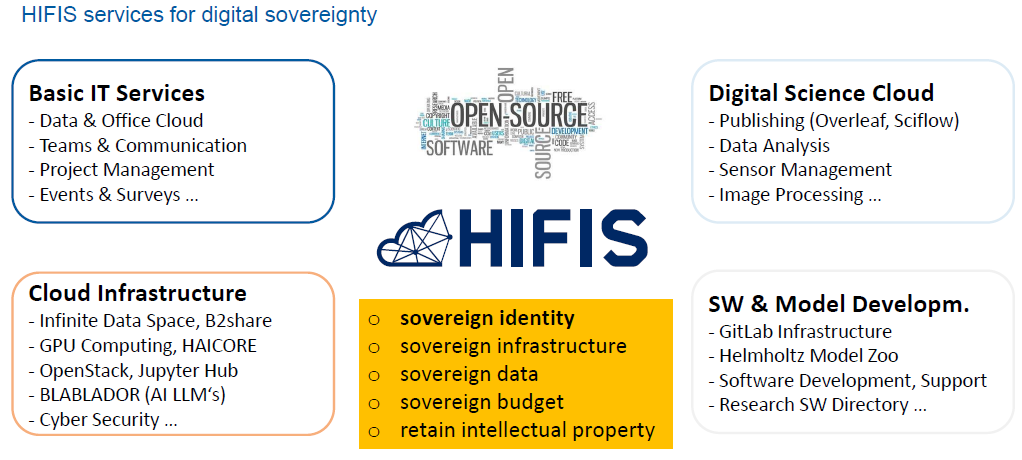
But that is not all. With the support of HIFIS Software Services, sustainable open-source software is being developed, and new sustainable cloud services for the scientific community are being introduced. Currently, about 30% of the more than 40 cloud services have been developed based on research by Helmholtz and its partners. This also includes AI-related services such as Blablador, a self-hosted AI/LLM environment. Currently about 500 research software packages are registered in the Helmholtz Software Directory, the best applications are awarded with the Helmholtz Software Prize annually.
Open Source Alone is not Enough
At the same time, our operational experience has shown that simply using software marketed as “open” does not automatically guarantee sovereignty.
The evolution of our Helmholtz Chat Service provides a concrete example of this. The Helmholtz Chat Platform, so far based on Mattermost, has transformed communication across the Helmholtz Association and its partners. With over 7,000 active monthly users by beginning of 2026, the service formed the backbone of communication for numerous projects. But Mattermost announced fundamental changes to its licensing strategy in 2025, which effectively left the service unusable for us from mid-2026. This is why we have transitioned to Matrix in a joint effort of strong partners – we remain sovereign!
Sovereignty Requires Participation
In times of constrained public budgets, this also raises broader questions about how digital spending is allocated. Recurring licensing costs and dependencies on proprietary cloud ecosystems often transfer substantial public resources into infrastructures over which institutions have little influence. Redirecting at least part of this investment toward open source ecosystems, local expertise, and collaborative infrastructure could strengthen Europe’s long-term technological resilience while simultaneously supporting innovation and public-sector capability building.
Research infrastructures have historically contributed to Europe’s scientific sovereignty. Increasingly, they also contribute to its digital sovereignty – not by isolating themselves, but by building open and federated digital foundations like HIFIS.
The current European debate around digital sovereignty therefore should not only focus on where software comes from. The more important question is whether institutions retain the practical ability to understand, operate, adapt, and sustain the digital systems on which they increasingly depend.
Changelog
- 2026-06-02: fix Blablador case and update HIFIS-related services pic